The quality of your AI output is directly related to the quality of your prompts. Learn how to craft prompts that get results.
The difference between mediocre and exceptional AI-generated content often comes down to one thing: the quality of your prompts. Whether you're using GPT, Claude, or Mistral AI, these 10 proven techniques will help you get dramatically better results.
1. Be Specific and Detailed
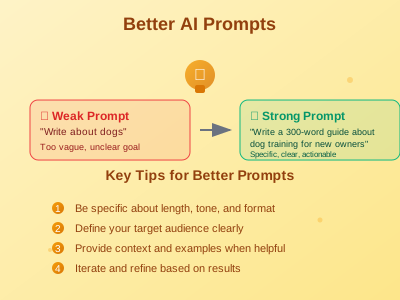
Vague prompts lead to vague results. Instead of asking "Write about dogs," try "Write a 500-word informative article about the health benefits of dog ownership for seniors, including both physical and mental health aspects."
❌ Weak Prompt:
"Write a marketing email."
✅ Strong Prompt:
"Write a marketing email for a SaaS productivity tool, targeting small business owners. The email should introduce our new time-tracking feature, highlight 3 key benefits, include a clear call-to-action, and maintain a professional yet friendly tone. Keep it under 200 words."
2. Define Your Audience
AI performs much better when it knows who it's writing for. Always specify your target audience's expertise level, interests, and context.
- "Explain quantum computing to a high school student"
- "Write for busy executives who need quick insights"
- "Target parents of young children"
- "Address experienced software developers"
3. Set the Tone and Style
Don't leave tone to chance. Explicitly state how you want the AI to sound. This is especially important for brand consistency and audience appropriateness.
4. Provide Context and Background
Give the AI the background information it needs to understand your request fully. Context helps the AI make better decisions about content, tone, and approach.
Example with Context:
"I'm launching a new eco-friendly cleaning product line. My target customers are environmentally conscious families with children. Write a product description for our all-purpose cleaner that emphasizes safety, effectiveness, and environmental benefits."
5. Use Examples and Templates
When you have a specific format or style in mind, provide examples. This is one of the most effective ways to get consistent, high-quality output.
Try phrases like:
- "Write in the style of [specific example]"
- "Follow this format: [provide template]"
- "Here's an example of what I'm looking for: [example]"
6. Break Complex Tasks into Steps
For complex requests, break them down into smaller, manageable parts. This approach leads to more thorough and organized output.
Instead of:
"Create a complete marketing strategy for my startup."
Try:
"Help me create a marketing strategy for my B2B SaaS startup. Please: 1. Identify our target customer segments 2. Suggest 5 marketing channels to focus on 3. Create a content calendar outline for the first month 4. Recommend key metrics to track"
7. Specify Output Format
Tell the AI exactly how you want the information presented. This saves time on reformatting and ensures you get usable output immediately.
- "Present as a bulleted list"
- "Format as a table with columns for..."
- "Write as a step-by-step guide"
- "Structure as an FAQ"
- "Create as a comparison chart"
8. Set Constraints and Limitations
Constraints actually improve AI output by forcing focus and preventing rambling. Set clear boundaries for length, scope, and content.
9. Use Role-Playing
Ask the AI to take on a specific role or persona. This technique can dramatically improve the relevance and quality of responses.
"Act as a marketing expert..."
"You are a financial advisor speaking to a first-time investor..."
"Respond as a customer service representative..."
"Take the role of a technical writer..."
10. Iterate and Refine
Don't expect perfection on the first try. Use follow-up prompts to refine and improve the output. This iterative approach often produces the best results.
Follow-up prompts:
- "Make this more concise"
- "Add more specific examples"
- "Adjust the tone to be more professional"
- "Focus more on the benefits rather than features"
- "Reorganize this with the most important points first"
Putting It All Together
Here's an example that incorporates multiple techniques:
Complete Example Prompt:
"Act as a content marketing expert writing for small business owners who are new to
social media marketing. Create a beginner-friendly guide titled '5 Social Media Mistakes
That Are Killing Your Small Business Growth.'
Format: Write as a listicle with an introduction, 5 numbered sections (one per mistake),
and a conclusion with actionable next steps.
Tone: Helpful and encouraging, not condescending. Use simple language and avoid jargon.
Length: 800-1000 words total.
Include: For each mistake, explain why it's harmful and provide a specific solution.
Add at least one real-world example per section."
Common Mistakes to Avoid
- Being too vague: "Write something good about AI"
- Asking for too much at once: Trying to get a complete business plan in one prompt
- Forgetting to specify format: Getting a wall of text when you wanted bullet points
- Not providing context: Asking for industry-specific content without mentioning the industry
- Giving up after one try: Not using follow-up prompts to refine the output
Practice Makes Perfect
Like any skill, prompt writing improves with practice. Start applying these techniques today, and you'll quickly see the difference in your AI-generated content quality.
Remember: the goal isn't to write the perfect prompt on the first try, but to develop a systematic approach that consistently produces better results. With these 10 techniques in your toolkit, you're well on your way to becoming a prompt engineering expert.